-
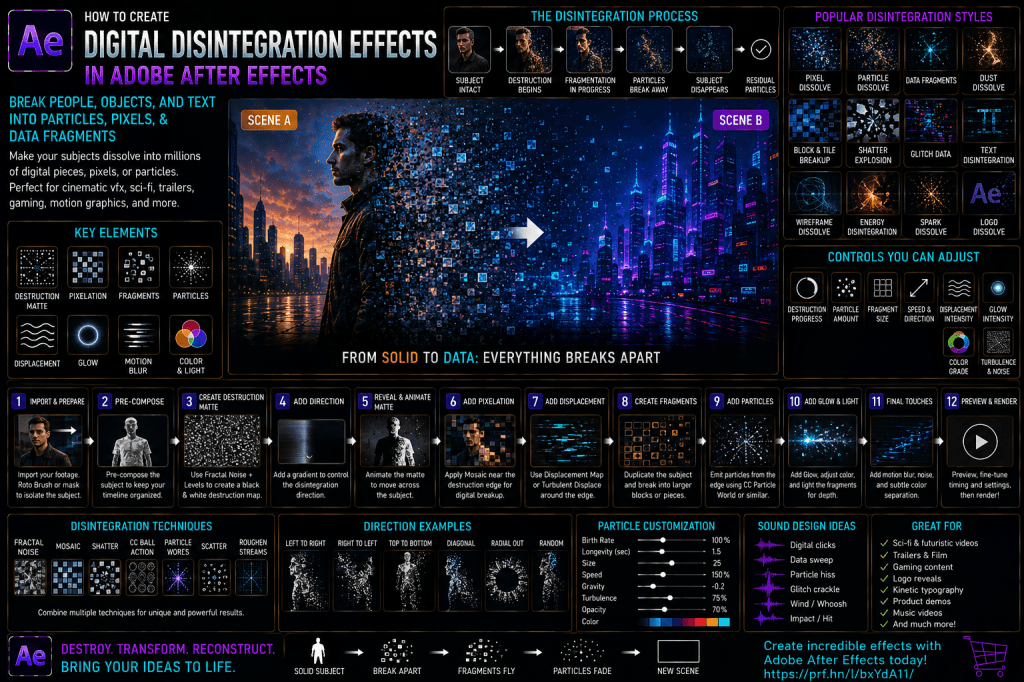 Continue reading →: How to Create Digital Disintegration Effects in Adobe After Effects: Break People, Objects, and Text into Particles, Pixels, and Data Fragments
Digital disintegration is one of the most versatile visual effects you can create in Adobe After Effects. A person can dissolve into thousands of particles. A logo can break apart into glowing pixels. Text can fragment into digital blocks. A product can disappear from one side to the other. An…
-
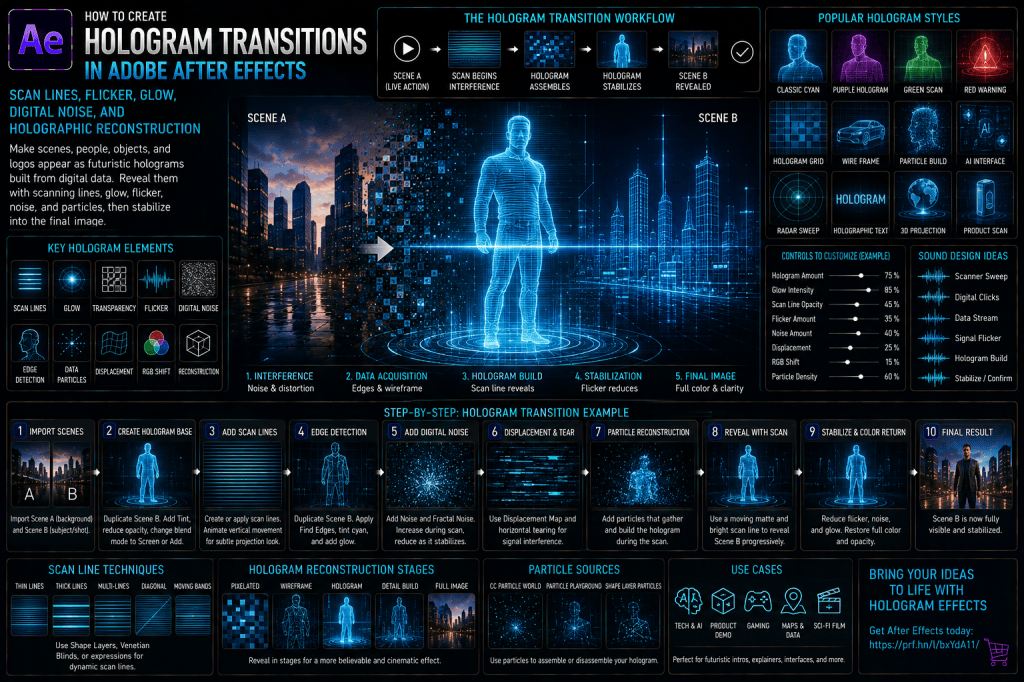 Continue reading →: How to Create Hologram Transitions in Adobe After Effects: Scan Lines, Flicker, Glow, Digital Noise, and Holographic Reconstruction
Hologram transitions can make a person, object, product, or entire environment appear as though it is being digitally projected into the scene. Instead of simply fading from one shot to another, the new image can begin as scattered digital information. Particles appear. Thin scan lines flicker into view. Edges become…
-
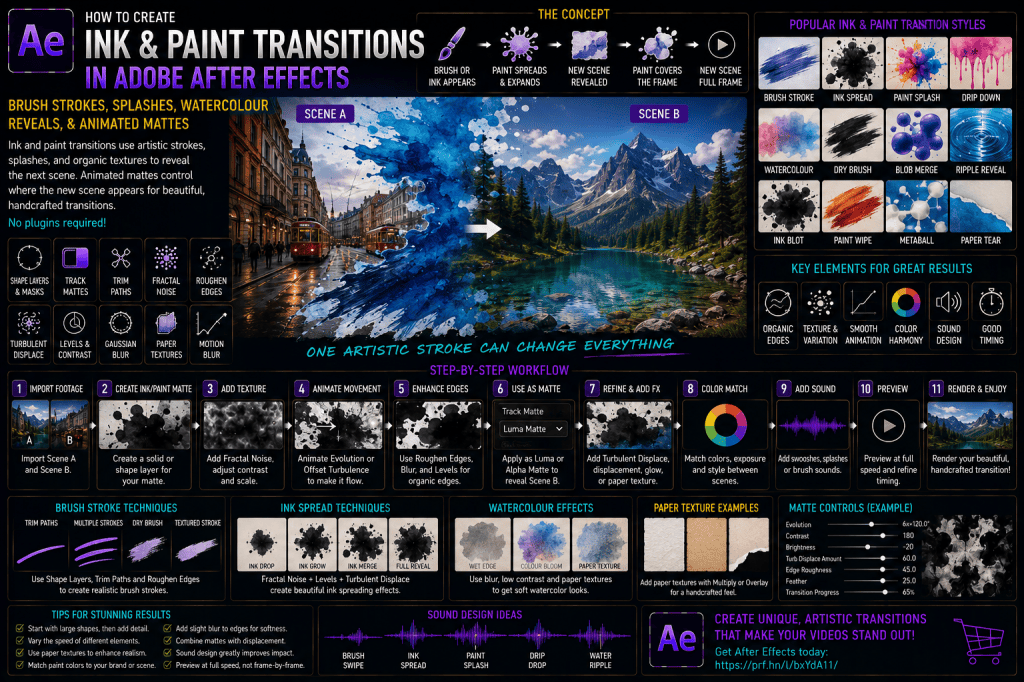 Continue reading →: How to Create Ink and Paint Transitions in Adobe After Effects: Brush Strokes, Splashes, Watercolor Reveals, and Animated Mattes
Ink and paint transitions can make a scene feel hand-crafted rather than digitally wiped from one shot to another. A brush stroke can sweep across the frame and reveal a new scene. Ink can spread outward organically until the next shot fills the composition. Watercolor can bloom across textured paper.…
-
Continue reading →: How to Create Glitch Transitions in Adobe After Effects: RGB Split, Digital Distortion, Signal Noise, and Frame Tearing
A glitch transition makes one scene appear to break apart digitally before another scene replaces it. Instead of hiding the cut behind a smooth blur or an organic matte, the edit is disguised by controlled visual errors: RGB channels separate. horizontal sections shift. pixels break into blocks. scan lines appear.…
-
 Continue reading →: How to Create a Digital Scan Transition in Adobe After Effects: Scanning Lines, Laser Sweeps, Holographic Reveals, and Data Reconstruction
A digital scan transition makes a scene appear as though it is being detected, analyzed, generated, or reconstructed by a machine. Instead of using a conventional wipe, the next image is revealed progressively by: The result can feel like a futuristic imaging system, AI scanner, security interface, holographic display, or…
-
 Continue reading →: How to Create Pixel Transitions in Adobe After Effects: Block Wipes, Mosaic Reveals, Pixel Dissolves, and Digital Tile Effects
Pixel transitions break an image into blocks, tiles, squares, or digital fragments and use those elements to reveal the next scene. Instead of simply dissolving from one shot to another, the image appears to: pixelate. fragment. rebuild. scatter. dissolve into blocks. reassemble from digital tiles. A landscape can progressively break…
-
 Continue reading →: How to Create Seamless Zoom Transitions in Adobe After Effects: Zoom Into One Scene and Fly Out of Another
A seamless zoom transition creates the illusion that the Camera continuously travels from one scene into another. You might zoom into: As the Camera moves closer, the image becomes larger and faster until the viewer loses most of the visual detail. At that moment, you switch to another shot. The…
-
 Continue reading →: How to Create Seamless Whip-Pan Transitions in Adobe After Effects: Match Fast Camera Movement, Motion Blur, and Speed Between Shots
A whip-pan transition can make two completely different shots feel like one continuous Camera movement. The Camera suddenly moves sideways. The image becomes heavily blurred. Visual detail disappears. The cut happens inside the blur. Then the second shot continues moving in the same direction before slowing down and revealing the…
-
 Continue reading →: How to Create an Energy Disintegration Effect in Adobe After Effects: Break People and Objects into Light, Sparks, Electricity, and Glowing Particles
Energy disintegration is a cinematic visual effect in which a person, object, logo, or other subject appears to transform into pure energy before disappearing. Instead of simply fading away, the subject goes through a visible transformation. Its surface begins to glow. Electrical arcs travel across it. Bright energy develops around…
-
 Continue reading →: How to Create an Energy Materialization Effect in Adobe After Effects: Build People and Objects from Light, Sparks, Electricity, and Glowing Particles
An energy materialization effect makes a person, object, logo, or other subject appear to form from concentrated light and electrical energy. The scene may begin completely empty. Small sparks appear. Glowing particles start gathering. Electrical arcs jump through the air. Light trails converge toward a central point. A luminous silhouette…
Hello,
I’m Ben

Welcome to After Effects Cloud, a place where I share my passion for Adobe After Effects, motion graphics, animation, and visual effects. I created this website to make learning After Effects easier, whether you’re opening the application for the first time or looking for new techniques to improve your creative work. Here you’ll find practical tutorials, feature guides, workflow tips, and updates covering the latest developments in After Effects. I’m constantly exploring new tools, including AI-powered features and the growing 3D capabilities inside After Effects, and I enjoy sharing what I discover along the way. I hope the articles inspire you to experiment, learn something new, and create amazing things with Adobe After Effects.
Let’s connect
Join the fun!
Stay updated with our latest tutorials and ideas by joining our newsletter.

